
Productive Farmland as a Diversifying Real Asset
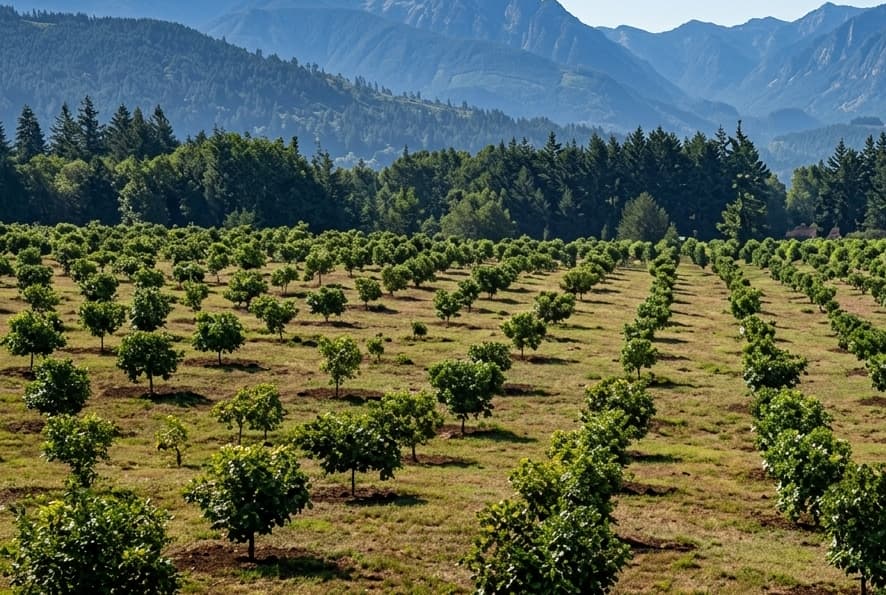
In portfolio terms, farmland belongs to a family called real assets, physical, productive things like land, infrastructure, and buildings, as opposed to paper claims like stocks and bonds. But the word that carries the weight in productive farmland is productive. This isn't raw acreage sitting idle, waiting to be flipped to a developer. It's working ground that grows something people need every single year, and that is exactly what makes it behave so differently from everything else in a portfolio.
The Return Profile: Income Plus Appreciation
Farmland earns its keep in two ways. The first is income: rent paid by farmers, or a share of the crop, arriving year after year largely regardless of what markets are doing. The second is appreciation: the gradual rise in the value of the land itself. Together, the NCREIF Farmland Index, the industry benchmark tracking institutional farmland performance since its 1991 inception, has averaged annual total returns of roughly 9.8% to 10.2%. That pairing of steady yield and long term growth is unusual, and it's why farmland reads more like a productive business than a speculative bet on land prices.
A Genuine Portfolio Diversifier
The heart of the case is correlation, or rather, the lack of it. Farmland returns have historically shown close to zero correlation with stocks and bonds, because they're driven by things that have little to do with market sentiment: rainfall, harvests, commodity prices, and global food demand. A review from the NCPERS notes that leased cropland has shown consistently lower correlation to GDP, stocks, and bonds than commercial real estate, while never posting a negative annual return prior to 2024. When equities sell off on rate fears or geopolitical shocks, a field of almonds keeps producing almonds. That independence is what genuine diversification looks like, not simply owning more things, but owning things that respond to different forces. It showed up clearly in 2022: as inflation hit a four decade high and both stocks and bonds posted losses amid rising rates, farmland held its value.
An Inflation Hedge With Structural Support
Farmland also has an unusually direct relationship with inflation. When the price of food rises, so does the income the land generates and, over time, the value of the land itself. Institutions have long cited this as one of the primary reasons for allocating to the asset class: farmland's historical role as an inflation hedge, paired with its low correlation to stocks and bonds and attractive risk adjusted returns, is a big part of the appeal for long horizon capital matching assets against liabilities that stretch decades ahead.
Volatility, Drawdown Risk, And The 2024 Correction
For all those return figures, farmland's defining trait has historically been how calm it is. Annualized volatility for the NCREIF Farmland Index has run around 6% to 7%, well below the roughly 17% to 19% typically seen in US stocks and public REITs, a materially smoother ride for a similar or better long run return. Land changes hands rarely and isn't repriced by the second, which is part of why it moves so slowly compared to public markets.
Worth stating plainly: 2024 broke the streak. For the first time since the index's 1991 inception, the NCREIF Farmland Index posted a negative annual total return of roughly 1.0%, driven by a pullback in permanent cropland amid soft commodity pricing and oversupply, most notably in almonds and pistachios. Income returns stayed positive throughout; it was the appreciation component that turned negative. Preliminary 2025 data points back toward positive territory, but the episode is a useful data point for calibrating expectations: farmland is low volatility relative to other assets, not volatility free.
Row Crops Versus Permanent Crops: A Risk Adjusted Distinction
Productive farmland spans a spectrum worth understanding, and the last two years are a good illustration of why.
Row crops, corn, soybeans, wheat, tend to offer steadier, lower income and more flexibility. This segment stayed roughly flat to positive through the 2024 downturn.
Permanent crops, tree nuts, citrus, avocados, and other orchard or vine crops, have historically produced higher returns than row crops in strong years, but they take years to reach full maturity, carry more commodity specific risk, and demand real operational expertise. That risk showed up directly in 2024 and 2025: almonds and pistachios went through a rough multi year stretch driven by oversupply and a strong dollar weighing on exports, pulling the permanent cropland segment as a whole into negative territory. It's a reminder that permanent crops aren't one uniform bet; performance varies meaningfully by crop, region, and export exposure, and a downturn concentrated in a couple of commodities can pull down the category average. There isn't yet an independent, crop specific benchmark for avocados the way there is for almonds or pistachios, so we'd caution against assuming any single permanent crop is insulated from the same cyclical pressures.
The choice between crop types shapes the income, risk, and growth profile of an allocation, which is why how you invest in farmland matters as much as whether you do.
Further reading: Farmland Investing: The Institutional Investment Case.
Liquidity And Structural Considerations
Farmland investing also comes with tradeoffs that don't show up in return figures. It's illiquid, you generally can't exit a position the way you can sell a stock. Minimums are often high, and there's no public daily price; valuations are appraisal based and update infrequently. A recent Forbes analysis makes the point directly: appraisal based pricing tends to smooth out farmland's reported volatility and correlation figures relative to what a continuously priced market would show. That smoothness is real in terms of how the asset trades, but it also means farmland isn't a substitute for capital you might need to access on short notice, and the low volatility numbers should be read with that caveat in mind.
The Portfolio Case
Add it up, and farmland occupies a specific, hard to fill slot in a portfolio: a real asset that produces income like a bond, has historically appreciated over the long run, offers some inflation protection, and moves largely independent of public markets, while carrying its own risks around illiquidity, crop concentration, and cyclical commodity pressure. For an investor building a portfolio meant to hold up across a range of conditions, it's a genuine diversifier worth understanding on its actual merits, both the durable long run case and the reminder 2024 provided that no asset class is without risk.
Disclaimer: This article is provided for general informational and educational purposes only and does not constitute investment, legal, or tax advice. Historical and index level performance figures are shown for context and do not represent the returns of any specific fund, product, or investment. Past performance is not indicative of future results. Farmland investments carry risks, including illiquidity, concentration risk, and sensitivity to commodity prices, weather, and interest rates, and are not suitable for all investors. Please consult a licensed financial, legal, or tax advisor before making investment decisions.