
Farmland vs. Commercial Real Estate: A Portfolio Allocation Perspective
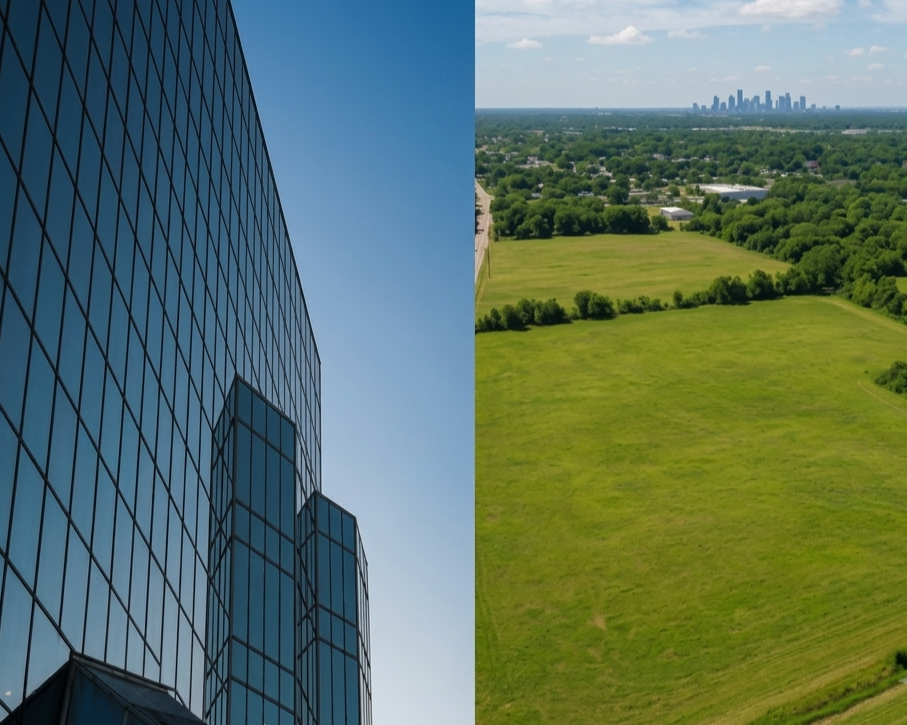
For an investor building out the real assets part of a portfolio, farmland and commercial real estate are natural candidates, and natural rivals for the same allocation. Both are tangible. Both produce income. Both have long been institutional staples. But they behave differently enough that the choice between them, or the split across them, is a real decision rather than a coin flip.
What They Share: The Common Ground Between Two Real Assets
Start with the common ground. Farmland and commercial real estate (CRE) are both physical, income producing assets held for the long term. Both earn returns from two sources, ongoing rent and appreciation in the value of the underlying asset. Both are illiquid, both offer some protection against inflation, and both have historically diversified away from stocks and bonds. For much of the past few decades they've been treated as cousins inside the same real assets bucket, and for good reason.
Where They Diverged: The Recent Evidence
The last three years pulled them sharply apart, and the contrast is instructive. As interest rates rose from 2022, commercial real estate went through one of its worst corrections since the financial crisis. Values across the NCREIF ODCE index, the main institutional benchmark, fell roughly 19% from their 2022 peak, with the damage concentrated in offices. NCREIF's property type data reported by Statista shows the office sector posting an annual return of about −16.7%, and analysis from the CRE Finance Council put prime central business district office values down around 40% from peak. NCREIF's fourth quarter 2024 index release shows the broader index only clawing back to a slightly positive +0.59% for the full year.
Farmland's ride through the same window was far gentler. It continued its long-run ~10% trajectory before finally posting a mild negative year in 2024 - its first in more than three decades. Where CRE was hit by rising rates and, in offices, a structural shift in how people work, farmland's core demand driver - people needing to eat - simply doesn't move with the economic cycle in the same way.
Why CRE Moves With The Economy And Farmland Doesn't
That's the crux of the comparison. CRE returns are tied to the economic cycle, to occupancy and rents, to financing costs, and increasingly to structural changes like remote work and e-commerce reshaping demand for offices and shops. It's also typically more leveraged, which amplifies both gains and losses when rates move. Farmland's value is anchored instead to agricultural productivity and long run food demand, which, according to ACPM's analysis of farmland as an inflation hedge, gives it lower volatility, roughly 6 to 7% a year, against the wider swings in property, and lower correlation to equities. Put simply, commercial real estate tends to behave like a leveraged play on the economy, while farmland behaves like a claim on a basic, non cyclical human need.
Further reading:Productive Farmland as a Diversifying Real Asset.
A Crowded Market Versus An Overlooked One
The two also sit at very different stages of institutional maturity. Commercial real estate is deeply institutionalized, with 10 to 20% of most property types held by institutions and a large, well developed transaction market. Farmland is the opposite.IREI's coverage of the growing opportunity in farmland investing notes that the US farmland market is more than twice the size of other US real estate classes combined, yet institutions own under 1% of it. CRE offers scale and liquidity; farmland offers a less efficient, less crowded field where disciplined buyers may find better pricing, at the cost of harder sourcing and a real need for operational expertise.
Not An Either/Or: Why Both Belong In A Portfolio
None of this makes one asset better. They do different jobs. Commercial real estate offers scale, higher current income in normal conditions, and exposure to urban and economic growth, and its recent repricing may even have created entry points for patient capital. Farmland offers stability, inflation protection, and a demand story largely disconnected from the business cycle, but it moves more slowly and is harder to access at scale. Within a real assets sleeve, the two can complement each other: CRE contributing income and cyclical upside, farmland contributing ballast and non correlation.
The Allocation Perspective
The practical takeaway is to treat real assets as a category with internal diversity, not a single line item. How you split between farmland and commercial real estate should depend on what you need the allocation to do. Reach for income and economic exposure, and CRE earns its place. Reach for resilience, inflation protection, and low correlation, and farmland does. The past few years made the case for holding both, and for understanding, before you allocate, exactly which job each one is there to perform.
This article is provided for general informational and educational purposes only and does not constitute investment, legal, or tax advice. Historical and index level performance figures are shown for context and do not represent the returns of any specific fund, product, or investment. Past performance is not indicative of future results. Farmland and commercial real estate investments carry risks, including illiquidity, concentration risk, and sensitivity to commodity prices, weather, financing costs, and interest rates, and are not suitable for all investors. Please consult a licensed financial, legal, or tax advisor before making investment decisions.